Showing posts with label activism. Show all posts

Monday, July 07, 2008

Free Book


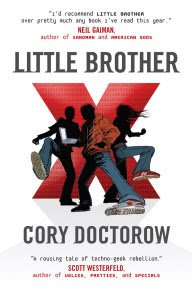
Educators can get a free copy of Cory Doctorow's Little Brother. I know I'm not the first to blog this, but I wasn't going to recommend it before I read it. Some educators may shy away from this one because it's main character is fighting the system and explains several ways of getting around security, including the security set up by schools.

Personally, I have no problem with this as it prompts the reader to think about what increased security really accomplishes and also what it should mean to live in a democracy. Definitely worth a read and if you can't afford to buy it and don't want to wait for someone to donate it then you can download the full text for free in many different formats.

Sunday, May 27, 2007

The Secretary of Education is soliciting comments on the importance of technology in the classroom. I strongly encourage everyone to go and post your thoughts. Unless you don't think we need technology in the classroom. If that is the case you should go here instead :)

You can find the survey at:
http://www.ed.gov/about/offices/list/os/technology/roundtable-form.html

Or, to read the call for comments, go to:
http://www.ed.gov/about/offices/list/os/technology/roundtable.html

Here are the survey questions, in case you want to prepare your answers:

Secretary Spellings would like to hear your ideas on the integration of technology in education. Please take a moment to provide feedback on the following questions:

1. In what ways has technology improved the effectiveness of your classroom, school or district?

2. Based on your role (administrator, parent, teacher, student, entrepreneur, business leader), how have you used educational data to make better decisions or be more successful?

3. In what ways can technology help us prepare our children for global competition and reach our goals of eliminating achievement gaps and having all students read and do math on grade level by 2014?

4. What should be the federal government's role in supporting the use of technology in our educational system?

Wednesday, April 11, 2007

DOE Report to Congress on Educational Software

I missed this when it first came out, but I've been seeing the repercussions all over the web. Recently the DOE released the findings of a study they'd done on the effectiveness of software in reading and mathematics. The basic finding was that software does not help. There are news articles and blogs that go into the details, but I recommend reading the primary source, or at least the executive summary.

The educational blogosphere has been yelling about this study and there feelings have been echoed by ISTE. The major claims are that the study is flawed, too narrow, and it doesn't take professional development (or lack of) of the staff into account. Many technology educators also complain that this study is contradicted by other studies they've read.

Before I launch into my rant core argument I should tell you a little about my background. I teach science and I am a self professed technology nerd. If you've read any of my past blog entries then you know this already. My educational background is varied, but my highest degree is a Masters of Science in Ecology and Evolutionary Biology (and ABD on my PhD). Anyone whose been to grad school as a science major will have spent quite a bit of time critically reading scientific research studies. You look for flaws in statistics, controls, experimental design, and conclusions drawn from the data presented.

I came to teaching high school later. As a part of my certification coursework I had to write a number of papers. My topic of choice typically was the effectiveness of technology in education. Being a technology nerd this was a logical choice, plus I wanted fodder for grant applications and justifications for my technology requests I could show to my principal.

Unfortunately I don't have my references if front of me right now. I'd promise to post them in a day or two, but every time I've done that in the past I've never done it. If there is a request then I will produce my references (or if I get really ambitious this week I'll do it without a request).

Overall I've read a number of studies on the effectiveness of technology in education. Unfortunately almost all of the studies had serious flaws. The most common flaw in educational research projects is a lack of a valid control. For example, when a new technology is being looked at for effectiveness, teachers who are given the new technology are also given significant professional development and are taught new teaching strategies that are supported by the technology (PBL, inquiry). They are then compared to a random collection of other teachers who have not been given any PD. In many cases the control teachers went through their teacher training before these strategies, which do not require technology, were shown to be effective. In these studies the gains in student performance are both statistically significant and significant enough that a lay person can't help but see the value.

In the one or two studies I've read where there were valid controls (i.e. pd for both the experimental and control groups) the gains are either not there or were very minor. In some areas the gains were statistically significant, but the magnitude of those gains was very small. The bottom line I walked away with was that technology is not the answer, but staff development is. Technology is simply another tool that a good educator can use to help their students.

Now, one might assume that I wouldn't support the wide spread use of technology in education. This assumption would be wrong. I recognize that technology does not make teachers better educators, but I still think we need to use it as much as possible. As many people point out we are preparing our students for a world that doesn't exist yet. Whatever awaits our students when they graduate from college, one thing can be sure, technology will be a part of it. Now, here comes my theory, and by this I mean wild conjecture that is not supported by any research.

By using the latest technologies in the classroom we expose or students to all the tools that are out there today and by doing so they should be more comfortable using the technology tools that well be developed in the future. We talk about how to prepare students to be responsible members of society (core democratic values) and we teach with writing across the curriculum and expect all teachers regardless of content area to follow along. Why shouldn't we expect all teachers to use all the tools at their disposal rather than only those they had twenty years ago?
Thursday, August 03, 2006

DOPA - Contact your Senators Soon!!!

H.R. 5319 - The Deleting Online Predators Act (DOPA) passed the House last week 416-15. The only reason it passed is it's title. The bill tries to protect young people by legislating the blockage of sites like MySpace in schools and libraries. The wording on the bill is very broad and would require the blocking of all commercial websites that keep user profiles, allow journaling, and allow direct communication between users.

Now, to me this sounds like most Web 2.0 sites out there. Some people have been interpreting it in such a way as to include sites like Amazon and eBay. What the House failed to do was even listen to the arguments made against the bill and voted for it because of its name.

Here is a quote from Congressman John Dingell the ranking member of the Energy and Commerce Committee:

"Mr. Speaker, I oppose these Internet predators. My good friend, for whom I have great respect, the chairman of this subcommittee from Michigan, opposes them. Everybody else in the Chamber opposes them. Every right-thinking and decent American opposes this practice. What we need, however, is good legislation which will address the problem. What we need is legislation which will be effective.

The Committee on Energy and Commerce had a number of hearings on these matters. It is interesting to note that, in the process of that, you can't find anything about there being a problem at schools and libraries. Now, this legislation has attracted both the strong opposition of the schools and the libraries and the Chamber of Commerce, which points out to us that this bill needs more work. In other words, Mr. Speaker, this bill is not ready for prime time."

I highly encourage you to read his full statement. He goes on to say he's going to vote for the bill (which he did) out of a political necessity, even though he knows it's a poorly written piece of legislation that will not protect our children.

Now, don't get me wrong. I believe we do need to protect our kids from online predators. I just don't feel that blocking is the way to go. My school already blocks MySpace because it has been deemed to have no educational value. At the same time most of those students interested know how to get around our filters.

What we really need is more money for law enforcement to hunt down these preadators and stiffer punishments. We need to target the predators rather than further burden the educational system.

The bill is now headed off the the Senate. No matter how you feel about this issue you should contact your Senators and let them know.

For further reading I highly recomend:

Energy and Commerce Committee Hearing Witness Transcripts, particularly Beth Yoke Executive Director ALA Young Adult Library Services Association.

David Warlick - http://davidwarlick.com/2cents/2006/07/25/call-your-representative-today/

http://weblogg-ed.com/ - Scroll down and you'll see a number of entries

http://news.yahoo.com/s/nf/20060801/bs_nf/45024 - The article I saw on Digg that made me aware of this.

Technorati Tags: , ,