A couple of weeks ago I blogged about the Hot Wheels Radar Gun. When I looked through my traffic for the last week (using Google Analytics) I saw "Hot Wheels Radar Gun" pop up as the most common search terms leading readers to my blog. So I decided I should probably conclude my testing to determine if it works.
After my last installment I had the feeling that it worked for constant velocity. I have confirmed that it works surprisingly well. I still need to experiment with accelerating objects though.
Experiment #3: Velocity of a constant velocity car
I experimentally determined the speed of my constant velocity car by timing it over a distance of two meters. I arrived at an average velocity of 0.157 m/s after three trials. With the radar gun set to scale speed (1/64) and kph I was able to get a reading of 35. Every time I did it I got 35 exactly. This converts to an actual speed of 0.15 m/s. If I use the 0.157 as the expected value I arrive at a percent error of 4.5%. I think that's Great!!!
Experiment #4: Real Velocity
Fresh off the constant velocity car I decided to try a real car. So I drove around the empty parking lot at my school and shot the light posts as I went by. I got the same reading as my speedometer every time.
Updated Conclusion:
The Hot Wheels Radar Gun works!!! At least for relatively constant velocity objects. I still need to determine how accurately it will measure velocity on an accelerating body.
Technorati Tags: Motion, toys, education, falconphysics
Showing posts with label toys. Show all posts
Showing posts with label toys. Show all posts
Saturday, September 23, 2006


Saturday, September 09, 2006
HotWheels Radar Gun
 UPDATE (7/20/08) - Please excuse me modifying my post some two years later, but This post sees a lot of traffic. I did more experimentation after I wrote this, for the full review follow this link.
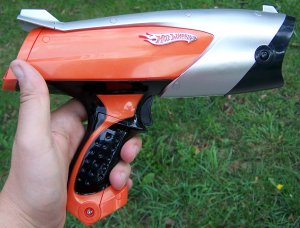
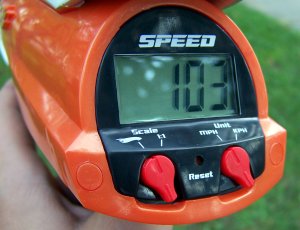
I just bought a Hot Wheels Radar Gun to see if it was at all useful in physics or physical science. The radar gun is hand-held. While it was designed for smaller hands than mine (go figure, 35 year old physics teachers aren't the target audience) it is still easy enough to hold and use. You have two unit settings kph and mph and you have the choice of getting straight speed or hotwheels car scale speed (1:64). I've of course been working in scale speed so I can be more precise (hopefully). When you pull the trigger you get a live readout of speed. When you let go it reports the maximum speed measured.
Experiment #1: Determining g using a falling object (a book)
- I held the radar gun above the book pointed down
- The book is held 2 m off the ground and dropped
- Velocity is taken in kph with the scale speed setting (1:64)
- Result - using the equation a=(v^2)/(2d) I get a value of 5.16 m/s/s. Only about a 47% error. (were shooting for 9.8 m/s/s)
- If the book drifts out of the radar beam I don't get really big numbers. I've done this same experiment using Vernier motion sensors and if your target moves out of the "beam" the floor is shot given the impression that the object "teleported" instantaneously to the floor resulting in a really big velocity.
- The results are the same if the object is held really close to the gun as they are if you start further away. The Vernier motion sensor can't get a reading within 0.5 m or so.
- It was really hard to get consistent results. Tow out of three results would be the same, but the third would be wildly different.
- The "reaction time" of the gun may be slow. This would explain the lack of teleportation velocity and may explain why I never got a true value for the maximum velocity of my falling object. It may very well be that the gun doesn't work well with accelerating objects and will give me more consistent results with constant velocity objects.
- Next step - Try known constant velocity experiment.
- Read GPS unit wile attempting to not fall off and not run my son down (while going between 8 and 9 mph).
- My son shoots me with the radar gun staying in my path just long enough to get a good reading before diving to safety.
- Compare the results.
- The results are much more consistent than in Experiment #1.
- The numbers from the GPS unit and radar gun are fairly similar. It's tough to get a good reading from the GPS unit while not running my son down.
- My inital conclusions seem to be confirmed. A constant velocity seems to give a better answer. There was a 13% error between the radar gun and the GPS velocities. While this seems like a lot, I am not really concerned. I know neither the error rate of the radar gun nor the error in the velocity estimate of the GPS unit. The error inherent in both devices may be compounded. It is impossible to know without further testing.
- The radar gun may in fact be not too bad. After the first experiment I wasn't so sure.
Technorati Tags: Probeware, Vernier, Motion, toys, education, falconphysics
Subscribe to:
Posts (Atom)

