I just saw this yesterday. This guy (http://www.khanacademy.org/) started making videos to help his younger cousin learn algebra. Apparently he didn't know when/where to stop. Now he has over 1200 videos and receives something like 40,000 views a day. This has become his full time job! The implications of this whole story are pretty cool. They're both practical and mind-blowing.
On the practical side we have this huge library of videos we can use with our students. I haven't looked at all of them, but the ones I have looked at are pretty straight forward presentations that get right to the point of a lesson/standard. I wouldn't be surprised to learn that he starts with the standard and then builds a lesson to teach it. Most of the videos are 10-20 minutes in length and offer something a traditional lecture does not. The ability to pause and/or rewind without having to raise your hand and admit that you're "stupid".
On the mind-blowing side we have a couple of things. First is, Sal Kahn's method is totally reproducible. This means you can, if you're interested, create your own videos. Kahn uses a tablet device to write with his computer. You can get one on Amazon starting under $70. I'm not sure what program he uses for writing on the screen, but I've been playing with one called Uniboard, which offers a free version and allows you to record.
Or, if you have a camera that can record video you can also just set it up pointed at your hands and use a pencil and paper to compose your lessons. In any case you too can easily make videos and upload them to YouTube (or some other school friendly site) for your students, and it doesn't really take that much time.
The other mind-blowing aspect is that this guy was able to create these videos and in the process create his own career. Not only will he have donations and ad revenue to support him. I'm sure he'll be doing the lecture/keynote circuit. Yet another example to support Malcom Gladwell's assertions in Outliers (great book by the way). Kahn was in the right place at the right time, has ability (BS in Math from MIT), and was willing to work hard. He leveraged the internet and built a career literally from his own effort and intellect.
Showing posts with label cheap tech tool. Show all posts
Showing posts with label cheap tech tool. Show all posts
Wednesday, June 09, 2010


Thursday, July 16, 2009
Wiimote CPR Trainer?
Wow, this is really cool. Some smart people (Senior engineering students at Univ. of Alabama) out there have written a program to use the accelerometer in a Wiimote to help train people to do CPR correctly. The program is not available yet, but should be on the American Heart Association webstie in early fall 2009.
What makes this really cool is that it is a perfect example of an inquiry based project. While it was developed by seniors in college it could probably have been done by high school students. The skills needed to create this would be within the grasp of students I've had. It makes me wonder what other problems could be solved with the accelerometer in a wiimote...
For those interested in cool applications of Wii technology:
cross posted from FlosSceince
What makes this really cool is that it is a perfect example of an inquiry based project. While it was developed by seniors in college it could probably have been done by high school students. The skills needed to create this would be within the grasp of students I've had. It makes me wonder what other problems could be solved with the accelerometer in a wiimote...
For those interested in cool applications of Wii technology:
cross posted from FlosSceince
Sunday, February 25, 2007
Cheap Tech Tool: Non-Contact Thermometer
I recently purchased a non-contact thermometer from Harbor Freight Tools. I think I may be buying a few more. You just point it at a surface, push a button and a second later you have your temperature reading. In a matter of seconds you can compare the temperature of a window, window pane, and the wall surrounding the window. Or you can look at the temperature of the floor by an outside door and how it varies with distance from the door.
The one I've been playing with currently is running for $6.99 (I bought mine for $9.99). It has a temp range of -33 to 110 degrees C (-27 to 230 Deg.F) so is a little limited and I haven't been able to gauge it's precision yet. Its ease of use and price make up for any of it's shortcomings, however.
Possible Labs or Demos:
 from Harbor Freight Tools. I think I may be buying a few more. You just point it at a surface, push a button and a second later you have your temperature reading. In a matter of seconds you can compare the temperature of a window, window pane, and the wall surrounding the window. Or you can look at the temperature of the floor by an outside door and how it varies with distance from the door.
The one I've been playing with currently is running for $6.99 (I bought mine for $9.99). It has a temp range of -33 to 110 degrees C (-27 to 230 Deg.F) so is a little limited and I haven't been able to gauge it's precision yet. Its ease of use and price make up for any of it's shortcomings, however.
Possible Labs or Demos:
- Black absorbs heat more quickly, does it radiate more heat than white?
- Insulators and conductors - Both may be the same temperature, but do they feel the same
when you touch them? A piece of Styrofoam and metal fresh from the fridge or freezer would do nicely.
- You can replace melting wax on the ends of conductors with a quantifiable temperature.
- Resistors in a circuit, which ones get the hottest? Why?

Saturday, September 23, 2006
HotWheels Radar Gun Take Two
A couple of weeks ago I blogged about the Hot Wheels Radar Gun. When I looked through my traffic for the last week (using Google Analytics) I saw "Hot Wheels Radar Gun" pop up as the most common search terms leading readers to my blog. So I decided I should probably conclude my testing to determine if it works.
After my last installment I had the feeling that it worked for constant velocity. I have confirmed that it works surprisingly well. I still need to experiment with accelerating objects though.
Experiment #3: Velocity of a constant velocity car
I experimentally determined the speed of my constant velocity car by timing it over a distance of two meters. I arrived at an average velocity of 0.157 m/s after three trials. With the radar gun set to scale speed (1/64) and kph I was able to get a reading of 35. Every time I did it I got 35 exactly. This converts to an actual speed of 0.15 m/s. If I use the 0.157 as the expected value I arrive at a percent error of 4.5%. I think that's Great!!!
Experiment #4: Real Velocity
Fresh off the constant velocity car I decided to try a real car. So I drove around the empty parking lot at my school and shot the light posts as I went by. I got the same reading as my speedometer every time.
Updated Conclusion:
The Hot Wheels Radar Gun works!!! At least for relatively constant velocity objects. I still need to determine how accurately it will measure velocity on an accelerating body.
Technorati Tags: Motion, toys, education, falconphysics
After my last installment I had the feeling that it worked for constant velocity. I have confirmed that it works surprisingly well. I still need to experiment with accelerating objects though.
Experiment #3: Velocity of a constant velocity car
I experimentally determined the speed of my constant velocity car by timing it over a distance of two meters. I arrived at an average velocity of 0.157 m/s after three trials. With the radar gun set to scale speed (1/64) and kph I was able to get a reading of 35. Every time I did it I got 35 exactly. This converts to an actual speed of 0.15 m/s. If I use the 0.157 as the expected value I arrive at a percent error of 4.5%. I think that's Great!!!
Experiment #4: Real Velocity
Fresh off the constant velocity car I decided to try a real car. So I drove around the empty parking lot at my school and shot the light posts as I went by. I got the same reading as my speedometer every time.
Updated Conclusion:
The Hot Wheels Radar Gun works!!! At least for relatively constant velocity objects. I still need to determine how accurately it will measure velocity on an accelerating body.
Technorati Tags: Motion, toys, education, falconphysics
Saturday, September 09, 2006
HotWheels Radar Gun
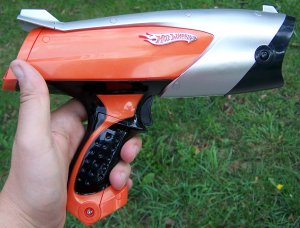 UPDATE (7/20/08) - Please excuse me modifying my post some two years later, but This post sees a lot of traffic. I did more experimentation after I wrote this, for the full review follow this link.
I just bought a Hot Wheels Radar Gun to see if it was at all useful in physics or physical science. The radar gun is hand-held. While it was designed for smaller hands than mine (go figure, 35 year old physics teachers aren't the target audience) it is still easy enough to hold and use. You have two unit settings kph and mph and you have the choice of getting straight speed or hotwheels car scale speed (1:64). I've of course been working in scale speed so I can be more precise (hopefully). When you pull the trigger you get a live readout of speed. When you let go it reports the maximum speed measured.
Experiment #1: Determining g using a falling object (a book)
- I held the radar gun above the book pointed down
- The book is held 2 m off the ground and dropped
- Velocity is taken in kph with the scale speed setting (1:64)
- Result - using the equation a=(v^2)/(2d) I get a value of 5.16 m/s/s. Only about a 47% error. (were shooting for 9.8 m/s/s)
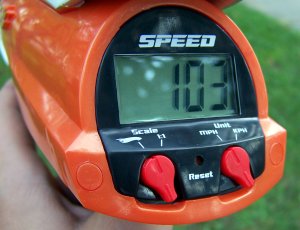
- If the book drifts out of the radar beam I don't get really big numbers. I've done this same experiment using Vernier motion sensors and if your target moves out of the "beam" the floor is shot given the impression that the object "teleported" instantaneously to the floor resulting in a really big velocity.
- The results are the same if the object is held really close to the gun as they are if you start further away. The Vernier motion sensor can't get a reading within 0.5 m or so.
- It was really hard to get consistent results. Tow out of three results would be the same, but the third would be wildly different.
- The "reaction time" of the gun may be slow. This would explain the lack of teleportation velocity and may explain why I never got a true value for the maximum velocity of my falling object. It may very well be that the gun doesn't work well with accelerating objects and will give me more consistent results with constant velocity objects.
- Next step - Try known constant velocity experiment.
- Read GPS unit wile attempting to not fall off and not run my son down (while going between 8 and 9 mph).
- My son shoots me with the radar gun staying in my path just long enough to get a good reading before diving to safety.
- Compare the results.
- The results are much more consistent than in Experiment #1.
- The numbers from the GPS unit and radar gun are fairly similar. It's tough to get a good reading from the GPS unit while not running my son down.
- My inital conclusions seem to be confirmed. A constant velocity seems to give a better answer. There was a 13% error between the radar gun and the GPS velocities. While this seems like a lot, I am not really concerned. I know neither the error rate of the radar gun nor the error in the velocity estimate of the GPS unit. The error inherent in both devices may be compounded. It is impossible to know without further testing.
- The radar gun may in fact be not too bad. After the first experiment I wasn't so sure.
Technorati Tags: Probeware, Vernier, Motion, toys, education, falconphysics
Sunday, August 21, 2005
Digital Microscope
I just bought a digital microscope from Toys R' Us for $30 off the clearance rack. I got it for my son to play with. It is the Digital Blue QX5. I've seen this type of scope before and was never really impressed, although I think this one is a slightly later generation than the versions I've seen.
Anyway, the original price is $100, which is probably a bit over priced. At $30 it is a great deal and highly recommend. If you can find it for under $60 or so I'd still say it is well worth it.
Specs:
Resolution: 640x480 (not great, but fine for on-screen viewing)
Can capture video: 15 frames per second
Time Lapse video: Settings from 1 pic/sec to 1 pic/min.
Magnification levels: According to the Scope 10x, 60x, 200x
Illumination: Top or bottom illumination, not both (at 200x it is a bit dim though)
Cool stuff: The light(s) are powered by the USB port so there is no need for batteries or an extra plug. The head can come off the base and allows for a lot of other use (like shots up your nose as my son demonstrated). There is even some picture editing built in and you can paint on the image. I'm not sure why you would want to do this, but my son is having fun turning a lady bug's spots from black to green even as I type this.
I bought this mainly for my son, but I may find a use or two for the scope in my own teaching. I'm looking forward to doing a time lapse video of a slime mold growing. If I taught k-6 students I'd buy as many as I could find (at $30) for my classroom.
Anyway, the original price is $100, which is probably a bit over priced. At $30 it is a great deal and highly recommend. If you can find it for under $60 or so I'd still say it is well worth it.
Specs:
Resolution: 640x480 (not great, but fine for on-screen viewing)
Can capture video: 15 frames per second
Time Lapse video: Settings from 1 pic/sec to 1 pic/min.
Magnification levels: According to the Scope 10x, 60x, 200x
Illumination: Top or bottom illumination, not both (at 200x it is a bit dim though)
Cool stuff: The light(s) are powered by the USB port so there is no need for batteries or an extra plug. The head can come off the base and allows for a lot of other use (like shots up your nose as my son demonstrated). There is even some picture editing built in and you can paint on the image. I'm not sure why you would want to do this, but my son is having fun turning a lady bug's spots from black to green even as I type this.
I bought this mainly for my son, but I may find a use or two for the scope in my own teaching. I'm looking forward to doing a time lapse video of a slime mold growing. If I taught k-6 students I'd buy as many as I could find (at $30) for my classroom.
Subscribe to:
Posts (Atom)


